
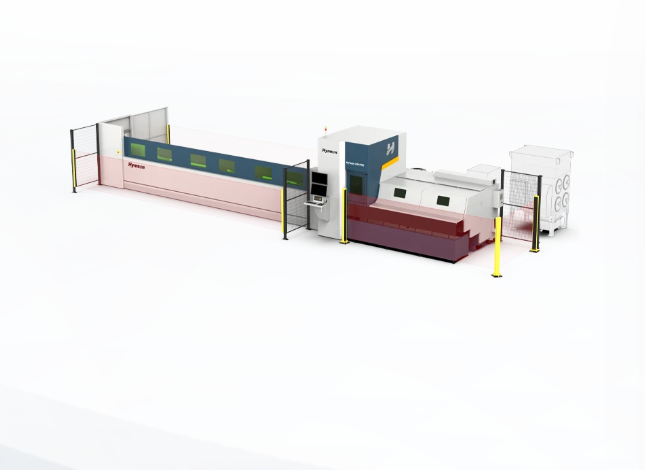
Clarifications to Seek When Reviewing Profile and Tube Laser Cutting Machines
Overview: defining the core problem
When a facility evaluates a profile or tube laser solution, ambiguity about capability and duty cycle causes costly missteps. Clarify the intended part types, material mix, and expected uptime before equipment demonstrations begin. If your review focuses on end-to-end production of structural tubes and intricate profiles, inspect a representative tube laser cutting system under load rather than relying on marketing sheets.
Critical specifications to confirm
Demand precise answers for wall-thickness limits, minimum/maximum tube diameters, and the material grades the machine reliably cuts. Ask for measured taper, kerf width, and repeatability figures over a specified run length. Confirm the control’s nesting efficiency and whether it supports true-shape import formats used in your shop. Require documentation of laser power modulation and beam delivery stability; vague responses signal risk.
Performance and quality checks to perform
Run test parts that reflect real production: cut the thinnest and thickest sections you’ll use, and include corners, holes, and mitered joints. Measure part-to-part dimensional variance and inspect edge quality under magnification. Check for burrs, thermal discoloration, and the need for secondary finishing. Time a series of consecutive parts to verify realistic cycle times and thermal drift over extended runs.
Operational and safety verifications
Verify automatic loading/unloading sequences, collision detection, and material clamping reliability. Confirm extraction and fume-management ratings for the metals you process. Examine guard interlocks, emergency stop behavior, and access controls; ask how the machine behaves during a fault and whether it preserves workpiece integrity. Ensure spare-parts lists and field-service response times are provided in writing.
Common mistakes reviewers make
Do not accept a single demonstration piece as proof of capability. Avoid basing decisions on peak power alone; thermal penetration and beam quality matter more. Do not overlook fixturing limits—many machines perform well on short samples but struggle with long or nonstandard sections. Reject vague servicing promises without defined SLAs and callout times.
Viable alternatives and trade-offs
Consider fixed-position profile cutters for high-precision, short-run work; they offer tighter tolerances but less throughput for long sections. Multi-head tube systems increase throughput for simple geometries yet add maintenance complexity. Fiber tube lasers balance speed and low operating cost; CO2 systems sometimes provide smoother finishes on certain alloys but require greater upkeep. Match machine topology to production rhythm, not aspirational volumes.
Experience, evidence, and expert anchoring
I have overseen commissioning programs for mid-size fabrication shops and advised on procurement that reduced rework by measurable margins. Seek independent test reports and factory acceptance documentation. Trade forums such as FABTECH in Chicago often showcase side-by-side demos where performance claims are corroborated by third-party observers; that kind of comparative exposure matters. When documenting claims, include a trial on a representative tube fiber laser cutting machine and retain the raw cycle-time data for contractual reference.
Final synthesis
Demand empirical proof, written service commitments, and real-world trials that match your production realities; those measures remove ambiguity and reduce lifecycle cost. When a supplier can show controlled demonstrations, clear specifications, and verifiable service records, the equipment becomes a predictable asset rather than a speculative purchase—an outcome many procurement teams have achieved through direct engagement with Hymson.