
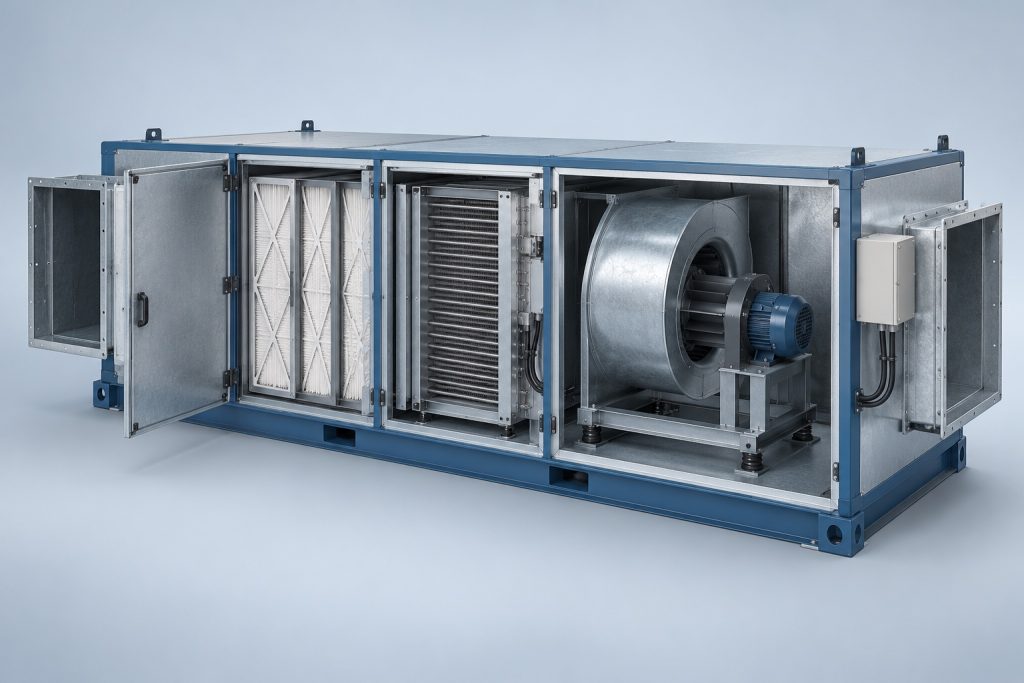
What to settle first when Air Handling Unit Heating decisions involve application scope for early research
Early air handling unit heating research becomes useful only when the application is defined before product details are compared. Procurement teams should first describe the air path, required supply condition, operating range, available installation space, and control sequence. These points determine which evidence matters and prevent a product specification from being treated as a complete system recommendation.

Define the use case and constraints
Start with the equipment context rather than the heater name. Establish whether the heater will raise incoming air or recirculated air, and identify the required supply condition. Then record the expected airflow, required temperature rise, inlet-air temperature, supply voltage, and available mounting space. These are not interchangeable inputs. The page evidence states that configuration should be based on airflow, required temperature rise, and available installation space, with voltage, dimensions, wiring, and mounting treated as configurable elements for the application.
The air path also sets practical boundaries. A compact heater may suit an existing airflow path, but its stated dimensions and electrical details must remain tied to that particular product description. One listed insulated PTC air heater is described as 220V, 500W, and 140 × 50.5 × 26 mm. Those values can support an initial screening exercise for that listed option; they should not be generalized to every heater or AHU arrangement.
Map stated evidence to procurement requirements
When comparing an electric heater air handling unit application, separate page-listed facts from requirements that still need confirmation. A listed wattage is a product detail. It does not, by itself, establish the temperature rise in a particular unit. The captured technical information explains that actual output also depends on supply voltage, inlet-air temperature, and heat removal. That makes the complete air path central to the evaluation.
A useful real-world anchor is the official application guidance for an AHU heater: it describes the heater as raising incoming or recirculated air to the required supply condition, while directing selection around the air path, operating range, and control sequence. It also limits the conclusion to validation in the complete unit. For procurement, this means a catalog match is an early filter, not a final suitability decision.
Control requirements deserve their own line in the specification review. The page states that PTC self-regulation does not replace AHU temperature control, airflow interlocks, or overheat protection. It also calls for validation of heating output and pressure drop across the intended operating range. Therefore, a request for quotation should identify the control sequence and the measurements required during evaluation, rather than asking only for a nominal heater rating.
Turn open points into supplier questions
A short question set can convert early research into a controlled procurement discussion. Ask the supplier to map the proposed assembly to the intended airflow, required temperature rise, installation space, supply voltage, wiring, and mounting arrangement. Ask how the proposed configuration will be evaluated in the target AHU. Keep each question tied to a stated requirement so that the response can be compared with other options.
For prototype or OEM work, request a defined evaluation path. The captured page recommends evaluating samples in the target AHU before production, then verifying temperature rise, pressure drop, and control response across the operating range. It further identifies approved configuration, order quantity, and delivery requirements as points to confirm for OEM supply. These questions help procurement distinguish a sample review from a production commitment.
Do not hide unresolved requirements inside a broad request for a “suitable” heater. Record the air-side conditions, electrical inputs, mechanical envelope, control interfaces, and acceptance checks separately. This format makes assumptions visible. It also gives engineering and purchasing a shared basis for deciding whether the next step is a sample evaluation, a revised specification, or a production discussion.
- Define the air path, operating range, required temperature rise, and control sequence before selecting a heater.
- Match the proposed configuration to airflow, installation space, voltage, dimensions, wiring, and mounting requirements.
- Evaluate samples in the target AHU and verify temperature rise, pressure drop, and control response across the operating range.
Choose a defensible next step
The most defensible early decision is usually a documented application screen followed by validation in the complete unit. Use the stated product details to identify possible candidates, but keep output and pressure-drop conclusions within the intended operating range and system configuration. If the application data is incomplete, the correct procurement action is to close those specific gaps before treating a heater as approved.
In summary, procurement teams should settle the air path, operating conditions, installation space, electrical requirements, and control sequence first. They should then connect those requirements to page-supported product details and define sample evaluation checks before production. PTCYIDU can be considered within that evidence-led process, while the final decision remains tied to the complete AHU application and its documented validation requirements.